Wednesday, May 20, 2020

‘The Democrats never learn’


Since 2016, just after Democratic nominee Hillary Clinton lost the United States presidential election to a Republican pickup winning Donald Trump, there has been a phrase often repeated.

The Democrats never learn.

This is about corporate Democrats rejecting progressivism—and some progressives, actual progressives, thinking the corporate Democrats are wrong in their understanding of the electorate and the period in which we are living.

This comes from those who voted the 2016 Democratic presidential nomination not to Hillary Clinton but to Bernie Sanders.

The Democrats never learn.

The progressives have it wrong.

Who hasn’t learned—at least not yet—are those progressives who are still being a part of the Democratic Party.

Being a part of the Democratic Party involves not just running for office in the Democratic Party. It also includes voting for the Democratic Party.

The Democrats—the corporate Democrats—do not have “their blinders on,” which are words used in the above Hard Lens Media video. (That video commentary is about the party’s recent loss, in a Republican pickup, of the special U.S. House election in California’s 25th Congressional District.)

The corporate Democrats have the party they, for the most part, want.

What the corporate Democrats really want, if they could get it to work out for them, was revealed and explained in 2014 by New York U.S. senator and minority leader Chuck Schumer.

“For every blue-collar Democrat we lose in western Pennsylvania, we will pick up two moderate Republicans in the suburbs in Philadelphia—and you can repeat that in Ohio and Illinois and Wisconsin.”

I will re-post the quote with the emphasis (in bold) which allows one to accurately read between the lines of that important message.

“For every blue-collar Democrat we lose in western Pennsylvania, we will pick up two moderate Republicans in the suburbs in Philadelphia—and you can repeat that in Ohio and Illinois and Wisconsin.”

Chuck Schumer, and the rest of his fellow corporate Democrats, would like to choose—if they can—for their voters to be Republicans.

[Republicans] are who and what Chuck Schumer and his fellow corporate Democrats want.

It’s who they are.

Monday, May 18, 2020

‘Leftists Jump the Corporate Democratic Ship, Leaving Sanders Behind’


Black Agenda Report’s Glen Ford has a marvelous piece about numerous of the people who supported—and who voted—the 2020 Democratic presidential nomination to Bernie Sanders being unwilling to Vote Blue No Matter Who.

Link:

Leftists Jump the Corporate Democratic Ship, Leaving Sanders Behind


★ ★ ★ ★ ★


I also recommend the following by Black Agenda Report’s Quetzal Cáceres:

Link:

The Sheepdog Caucus and So-Called “Democratic” Socialists

Friday, May 15, 2020

Obamagate


Jimmy Dore welcomed as his guest Max Blumenthal to discuss Obamagate.

Monday, May 11, 2020

‘Ray McGovern: New House Documents Sow Further Doubt That Russia Hacked the DNC’


Last weekend, Consortium News published  this latest by former CIA analyst Ray McGovern about the falseness of Russia-gate.

Link:

Ray McGovern: New House Documents Sow Further Doubt That Russia Hacked the DNC


I want to share the following readers comment:


For two and a half years the House Intelligence Committee knew CrowdStrike didn’t have the goods on Russia. Now the public knows too.

Twin Pillars of Russiagate Crumble

Maybe so. I sure that this is correct. But, so what. Everyone ‘knows’ those devious Russians hacked the DNC. I would love this silly assertion not to be the case but this is how propaganda and manipulation works. It’s all about inference, and associationist thinking which slowly seeps into the popular consciousness and is taken to be objective ‘truth’.

“The typical citizen drops down to a lower level of mental performace as soon as he enters the political field. He argues and analyses in a way in which he would recognise as infantile withing the sphere of his own interests. He becomes a primitive again. His thinking becomes associative and affective … Information is plentiful and readily available. But this does not seem to make any difference … he is impatient of long complicated arguments. All of which goes to show that without the initiative which comes from immediate responsibility, ignorance will persist in the face of masses of information however complete and correct.”  
[Capitalism, Socialism and Democracy, by Joseph Schumpeter, 1942]


Sorry, I have to call it like I see it.

—Francis Lee, May 10, 2020

Sunday, May 3, 2020

Polling, Six Months from Election Day, Looks Good for the Ds


Dear Progressives Chat Readers,

The date of this blog topic is timed six months from the scheduled date of the general election—the United States presidential election (with even more elections)—on November 3, 2020. 

What you are about to read is not me making predictions. 

What you are about to read is me referring to poll reports.

This blog topic is, for the hell of it, supposing that what the polls say now is what they will say six months from now with the general-election matchup of Donald Trump vs. Joe Biden. 

I do keep in mind they may change, from what they say now, and they may not change.

What will play out over the next six months may be harder to predict. 

This is one of those things in which I realize my opinion isn’t of importance; it isn’t about whether I do have an opinion.

It is about trying to be aware, as much as one can ask of himself/herself, of what can play out.

—Candy83 


✪ ✪ ✪ ✪ ✪


If the poll reports that are current, and most recent, are reflective of what will play out in the general election—scheduled for Tuesday, November 3, 2020—then the White House will flip from the Republican to the Democratic column.

If these polls reports are what plays out on Election Day, the 2020 Democrats will be positioned to flip not only the presidency of the United States but also the United States Senate.

What would do it, in reality, is not just the low-approval job percentage polls of Republican incumbent U.S. president Donald Trump. That is part of it. Trump has been consistently in the negatives since his presidency began.

For Trump to win re-election: He can get by with about 48 percent in the U.S. Popular Vote and lose there with a margin of –3. (An outcome of 48 to 51 percent.) He would, in that scenario, carry 2016 tipping-point state Wisconsin, with its 270th electoral vote, and surrender Pennsylvania and Michigan. That would yield a re-election outcome of 270 to 268 electoral votes. (Refer to the list in “Mapping It Out: U.S. President.”) Those whisker-like results, very appealing to Electoral College Scenario Geeks, are more susceptible when the presidency flips to the opposition party which reached that minimum 270. That was the case with 2000 Republican pickup winner George W. Bush and his 271 electoral votes, up from 1996 losing nominee Bob Dole and his 159. But, for a 2016 Republican pickup winning Donald Trump, he finished with an original electoral-vote score of 306.

What would do it—to serve as the catalyst—is COVID–19. 

It would be COVID–19 having struck on Trump’s watch. 

It would be what COVID–19, in this pandemic crisis, for what it will have done to The People—the voting electorate—in terms of their economics and other matters heading into the general election.

This, and the following, is to keep in mind the date that we are six months from the general election. What these poll numbers are now may or may not be the case come November.


RCP on U.S. President: Democratic +5.3


Real Clear Politics has the average polling margin of the 2020 general-election matchup—Trump vs. Biden—as D+5.3.

If that were to turn out to be the results in the U.S. Popular Vote margin, it would suggest a Democratic pickup of the presidency with carriage of 27 states. (Refer, once again, to the list in “Mapping It Out: U.S. President.”) 

The range, from the most recently listed polls, is between Tie and D+10. Since 10 points is too wide a range, I would eliminated the highest, D+10, and the lowest, Tie, for perhaps a better balance. But, it moves up to just D+5.4.

That margin also suggests carriage of 27 states. (Formula: Add +28 to a winning Republican’s and +22 to a winning Democrat’s whole-number margin in the U.S. Popular Vote to estimate the number of carried states. A margin of +5 would yield 33 states for winning Republican and 27 states for a winning Democrat. From 1992 to 2016, winning Rs averaged 9 and 10 electoral votes per carried state; winning Ds have averaged overall 12 electoral votes per carried state.) That carriage of 27 states—for those specially estimated for where they would come in (see list, below)—would deliver an electoral map for 2020 Democratic presidential pickup up to Georgia and a cumulative 350 electoral votes.

Looking ahead to the next subheading, this is close—within 2 percentage points—to the average margin I write about regarding Real Clear Politics’s “2020 Generic Congressional Ballot.” 


RCP: Ds’ U.S. Popular Vote Margin Lead for U.S. House, +7.4

Since the year 2000, there has been a close alignment for U.S. Popular Vote for U.S. President vs. U.S. House.

The last two Republican presidential pickup winners—2000 George W. Bush and 2016 Donald Trump—did not flip the U.S. Popular Vote; but, had they, their margins would have been +2 (I explain, later), which were very close to the margins for U.S. House.

Since 2000, the party which won the U.S. Popular Vote for U.S. House also won for U.S. President.

The results:

ELECTION 2000
• U.S. President: R–0.51 (George W. Bush, pickup)
• U.S. House: R+0.41

ELECTION 2004
• U.S. President: R+2.46 (Bush, re-elected with an increased +2.97)
• U.S. House: R+2.64

ELECTION 2008
• U.S. President: D+7.26 (Barack Obama, pickup)
• U.S. House: D+10.60 (Ds flipped the U.S. House in 2006)

ELECTION 2012
• U.S. President: D+3.86 (Obama, re-elected with a decreased –3.40)
• U.S. House: D+1.16 (Ds lost the U.S. House in 2010)

ELECTION 2016
• U.S. President: R–2.09 (Donald Trump, pickup)
• U.S. House: R+1.08

From 2000 to 2016, which were the two previous decades of five election cycles, the margins spreads were: 0.92, 0.18, 3.34, 2.70, and 3.17. They averaged 2.06. The worst in spread was 3.34. So, as one sees with those numbers, there was been a close alignment.

Report from Real Clear Politics on the polls, for “2020 Generic Congressional Vote,” for U.S. House, reports a preference average of Democratic +7.4. The Ds have been up +5 (Politico/Morning Consult), +8 (Economist/YouGov), and +9 (Grinnell/Selzer). 

(Source: 2020 Generic Congressional Vote.)

Now, I don’t know how reliable such polling is, at this point, for what will actually play out over the next six months. They did measure up, at this time in 2018, for what were the midterm elections six months later. The 2018 Democrats, with having flipped the U.S. House, won with a U.S. Popular Vote margin of +8.56. 

This is something I would choose to not ignore.

I am sensing, whatever the U.S. Popular Vote margin for U.S. President, there will be, once again, a closely aligned result for U.S. House.

✪ ✪ ✪ ✪ ✪


Not Good—Six Months Out—for Trump, Republicans

The polls are not good, right now, for Republican incumbent U.S. president Donald Trump.

They are also not good for the Republican majority in the United States Senate.

There are some people who are thinking the 2020 Democrats can win a pickup of the presidency but not a likewise majority-control pickup of the U.S. Senate.

The history suggests otherwise.

The United States has seen, so far, ten incumbent presidents unseated with their efforts to win re-elections. Five of them occurred during the 20th century. The opposition-party challengers who unseated incumbent presidents were: 1912 Democratic challenger Woodrow Wilson unseated Republican incumbent William Howard Taft; 1932 Democratic challenger Franklin Roosevelt unseated Republican incumbent Herbert Hoover; 1976 Democratic challenger Jimmy Carter unseated Republican incumbent Gerald Ford; 1980 Republican challenger Ronald Reagan unseated Democratic incumbent Jimmy Carter; and 1992 Democratic challenger Bill Clinton unseated Republican incumbent George Bush.

What all five of them had in common is that their national margin shift, from the previous election cycle, was at least +10 percentage points in their direction of the results for U.S. Popular Vote. (I wrote about this here: The 2020 Democrats Who Are Wanting to Unseat Trump May Also Want A 10-Point National Shift.)

What should also be mentioned is this: When all five of them took office, they established same-party control of the United State Senate. Three of them—Wilson, Roosevelt, and Reagan—saw their party pickups of the presidency followed with likewise majority-control pickups of the U.S. Senate. (The 1912 Democrats prevailed, as majority pickup winners, just before the 17th Amendment.)


✪ ✪ ✪ ✪ ✪


Mapping It Out: U.S. President

The 2016 Democrats won the U.S. Popular Vote, for U.S. President, by +2.09. (It was: Donald Trump 45.93% vs. Hillary Clinton 48.02%.) It should have been a margin of Republican +2/Democratic –2. That is because, in presidential elections which flip party occupancy, the pickup winning Republican or Democrat tends to win a net gain of +1 to +1.5 (closer to +1) states with each percentage point nationally shifted in their direction. 

2016 Donald Trump, working from 2012 Mitt Romney’s margin of –3.86 (it was Romney 47.15% vs. Obama 51.01%), flipped the following: Top 10 populous states Florida, Pennsylvania, Ohio, and Michigan; No. 20 Wisconsin; No. 32 Iowa; and Maine’s 2nd Congressional District (roughly one-half its statewide vote). So, Trump’s national shift, had it lived up to normal historical voting pattern, would have been between +6 to +6.5, for an estimated U.S. Popular Vote margin between +2.15 to +2.64. (Trump and Hillary Clinton shifted some base states normally aligned to each other’s party. After the two previous cycles were won by the Democrats, Republican pickup winner Trump won over the electoral map. Hillary won a compromise in the form of a setup for the Democrats’ future with key emerging states—Arizona, Georgia, and Texas—by getting them to conspicuously underperform their Republican-level margins for Trump.)

The 2020 Democrats are starting at an adjusted U.S. Popular Vote margin of –2. Their 2016 map consisted of 20 states, plus District of Columbia, and an original 232 electoral votes.

If 2020 results in a Democratic pickup of the presidency, the Ds will have won the U.S. Popular Vote by no less than +4 (the level of 2012 Obama). If the U.S. Senate also flips, the U.S. Popular Vote will be no less than D+5. (The Ds are favored to lose Alabama because it is heavily aligned to the Rs. A Democratic presidential pickup winner would have to reduce Alabama to a single-digit margin, in a Republican hold, while their party’s incumbent U.S. senator, Doug Jones, would outperform his party’s presidential nominee by about 10 points so Jones can narrowly hold that seat.)

Here is my estimate (beginning with the 2016 Ds’ map of 20 states, plus D.C., with a starting point of 232 electoral votes) followed by these pickups (* were 2016 Republican pickups):

21. * Michigan (–0.22; cumulative 248 electoral votes)
22. * Pennsylvania (–0.72; cum. 268)
23. * Wisconsin (–0.76; cum. 278—Tipping-point state)
24. * Florida (–1.19; cum. 307)
— Nebraska’s 2nd Congressional District (–2.23; cum. 308)
25. Arizona (–3.50; cum. 319)
26. North Carolina (–3.66; cum. 334)

Listing up to the Tar Heel State is the 2020 U.S. Senate Democrats having reached 50 seats. To win more, a new majority with having flipped the U.S. Senate, involve the following for U.S. President:

27. Georgia (–5.10; cum. 350; U.S. Popular Vote margin: +5)
28. * Iowa (–9.41; cum. 356; U.S. Popular Vote margin: +6)
— * Maine’s 2nd Congressional District (–10.28; cum. 357; U.S. Popular Vote margin: +6.50)
29. Texas (–8.98; cum. 395; U.S. Popular Vote margin: +7)
30. * Ohio (–8.07; cum. 413; U.S. Popular Vote margin: +8)

Numbers 31 and 32 may come in as listed…or deliver in opposite order:

31. Montana (–20.24; cum. 416; U.S. Popular Vote margin: +9)
32. South Carolina (–14.27; cum. 425; U.S. Popular Vote margin: +10)

I cut off at 32 states. (Going higher would include states like Kansas and Nebraska—with its statewide and 1st Congressional District—as well as Utah and Alaska, and Missouri and Indiana.) This would be in the range, established since 1992, of presidential winners having carried between 26 and 32 states. Barack Obama, with re-election in 2012, won 26 states. Bill Clinton, with his first-term election in 1992, won 32 states. The average, from those 24 years and 7 election cycles, were 29 carried states.

Refer to map above. It is a best-case scenario for a 2020 Democratic pickup of the presidency.


✪ ✪ ✪ ✪ ✪


Mapping It Out: U.S. Senate

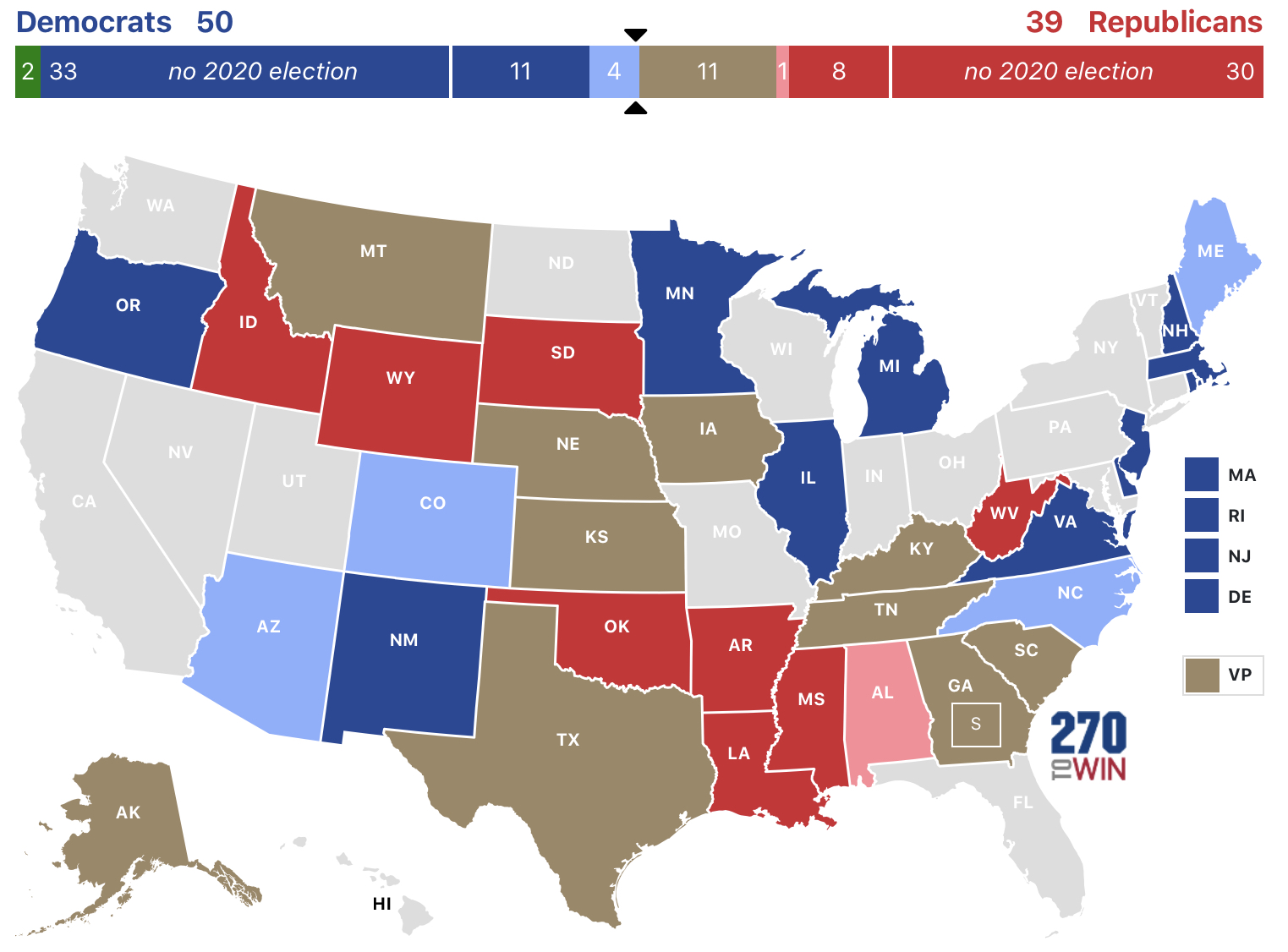
Looking at this from the perspective of a likewise 2020 Democratic majority-control pickup for the U.S. Senate: The Ds start with 47 and will likely lose Alabama. So, they begin with an adjusted 46. The following are an estimated order of pickups if they reach a new majority (and, perhaps, go a few seats beyond 51):

47. Colorado
48. Maine
49. Arizona
50. North Carolina (same-party—U.S. President and U.S. Senate—carriage results since 1972)

Tipping-point state (one of the following):

51. Georgia (special, first, then regular—a U.S. Popular Vote margin of +5 and +5.50)
53. Iowa (U.S. Popular Vote margin: +6)

Some people disagree on the orders of 51 to 53. For the 2020 Democrats to reach a majority-control pickup of the U.S. Senate, I don’t think any other state would become the tipping-point state.

If the numbers climb:

54. Texas (U.S. Popular Vote margin: +7)
55. Montana (U.S. Popular Vote margin: +8; Steve Bullock would run better than presumptive nominee Joe Biden with margins in Montana)
56. South Carolina (U.S. Popular Vote margin: +9)

To reach a supermajority of 60 seats, the 2020 Democrats would need to win pickups in four of the following five states: Alaska, Kansas, Kentucky, Nebraska, and Tennessee.

Refer to map above for the best-case scenario for not only a 2020 Democratic majority-control pickup but also a supermajority-control pickup of the Untied States Senate. (Solid shades are party holds. Light shades are party pickups. Those in neutral are currently with the incumbent majority party, the Republican Party.)

Disqus for progressiveschat-blogspot-com