
Progressives Chat will resume next week with a new topic.
I wish everyone a pleasant holiday.
Progressives Chat will resume next week with a new topic.
I wish everyone a pleasant holiday.

The 2022 midterm elections were a wave election.
They were not a wave election for the White House opposition Republican Party.
They were not a wave election for the White House Democratic Party.
This was not a Red Wave.
This was not a Blue Wave.
If one insists on a color, and that is understandable, this was more in the way of a Purple Wave.
Current trajectory for the United States House of Representatives, which has not been called by the date of this blog topic (but will become updated and mentioned should they be determined and projected during this week), is in favor of a Republican majority pickup.
The United States Senate, as determined last Saturday [November 11, 2022], was projected as a Democratic hold regardless the special election scheduled for December 6, 2022 in Georgia. (The outcome would be either 50-vs.-50 or 51-vs.-49 in favor of the Democrats.)
The type of wave election that best describes the midterm election of 2022 was one not experienced before.
The 2022 midterm elections was an Abortion Wave.
Yes—a midterms wave election which was for Reproductive Freedom.
The Roe v. Wade decision, from the U.S. Supreme Court, was in 1973. The 2022 repeal of that decision, in Dobbs v. Jackson, was an electoral gift to the 2022 Democrats. Had this not happened, they would have been on the wrong side of a wave election. A sufficient number of voters—nationwide and state after state—solidified their support to make sure the Republicans would not have their wave. (Side note: On this issue, I support Pro-Choice.)
This is, understandably, Pro-Choice females not wanting government to tell them whether or not they can have an abortion. (A sufficient number of males are also Pro-Choice.) I think there were plenty of people, including myself, who underestimated the level of just how critically important the role this issue would have, while anticipating and predicting, with the 2022 midterm elections. That Inflation, while the No. 1 issue with many, was outvoted by Abortion because, and I am guessing here, enough of the voting electorate are aware of enough of the past economic crises which have struck every so many years while this has not been so with Reproductive Freedom.
I had, during Election Week, predicted 240 and 52 seats for a majority-pickup winning Republican U.S. House and U.S. Senate. It has, over the last few days, been estimated the 2022 GOP is poised to win over the U.S. House with around 220 seats. (Required for majority are 218.) This is not even 51 percent of the U.S. House seats. To look back at a post-17th Amendment, dating back to the 1910s, for subsequent midterm elections: There were eight cycles, prior to 2022, in which the U.S. House flipped. (Those occurred in 1918, 1930, 1946, 1954, 1994, 2006, 2010, and 2018.) Of those eight, the U.S. House without the U.S. Senate flipped three prior times. (Those occurred in 1930, 2010, and 2018.) The remaining five cycles saw both houses of Congress flip. (Those occurred in 1918, 1946, 1954, 1994, and 2006.) In every case, the White House opposition party entered the next Congress with a higher percentage of seats in the U.S. House. (This helps explain why, when one flips, what comes first is the House.) The average number of newly established seats, based on their percentages (and rounded to their whole numbers), were 235 seats in the U.S. House. In seven of those past cycles, the opposition party established seats in the 230s or 240s. (The area of 53 to 55 percent of U.S. House seats.) Just once did it fall below 230. This occurred with the 1930 Democrats. They ended up with 219 seats. This is the estimated level which would be experienced by the 2022 Republicans. So, it is no wonder the 2022 Democrats will retain majority control of the U.S. Senate. (The upcoming runoff in Georgia, I will guess, is going to result in a Democratic hold for incumbent Raphael Warnock. I doubt the GOP will knock themselves out to try to get their nominee, Herschel Walker, to unseat Warnock in an effort to end up Even at 50-vs.-50. Based on how the votes have played out—nationally and state after state—it is likely this will have the same outcome.)
There were numerous Ballot Measures—ones which were favorable outcomes for The People—which are not limited to only particular state colors. They came from Red States, Blue States, and Purple States.
Given my summary of the 2022 midterm elections, especially for federal offices, were an Abortion Wave, four states were won by voters for Reproductive Freedom: California, Kentucky, Vermont and, especially noteworthy, Michigan. (In fact, the Michigan Legislatures resulted in the 2022 Democrats winning back power, for majority, for the first time in 40 years.) … Two states voted in favor to Legalize Marijuana: Missouri and North Dakota. … Two states voted for Minimum Wage Increase: Nebraska and Nevada.
Among other Ballot Measures, approved by voters, which should benefit The People: Alabama voted to Allow Internet infrastructure funding. … Arizona Voted to Impose new medical debt limits. … California voted to Require funding of K–12 art education. … Colorado voted to Create [a] “Healthy school meals for all” program. … Connecticut voted to Allow early voting. … Maryland voted to Change residency requirements for state legislative candidates. … Massachusetts voted to Increase taxes on incomes greater than $1 million. … Michigan voted to Change term limits for lawmakers; require annual financial disclosures [of officeholders]. … Montana voted to Require search warrant to access electronic data or or communications. … New York voted to Create “True cost of living” metric in New York City. … North Dakota voted to Limit governors and state legislatures to serving eight years in office.
One of this site’s regulars, cathyx, posted comment showing a color-coded map of the actual winners for the 2022 midterm elections (and you can apply this to every type of general election and specific year).
So…
The Ultimate Winners of the 2022 midterm elections are: The Oligarchs.
There will be no argument coming from me.

Tuesday, November 8, 2022 is Election Day for the 2022 midterm elections.
All 435 of the U.S.House seats are on the schedule.
Class #03 of the U.S. Senate—including a special election in Oklahoma—is on the schedule.
36 of the nation’s 50 states have gubernatorial elections on the schedule. This includes 9 of the nation’s Top 10 most-populous states. (Exception is North Carolina.) This includes New Hampshire and Vermont, the only two states whose governor terms are for a period of two, rather than four, years.
The October 24, 2022 Progressives Chat blog topic covered enough of my overall predictions—although it focused on U.S. House and U.S. Senate (not so much for U.S. Governors)—that I don’t feel the need to do that again with this week’s topic.
If available, I will post in comments any updates occurring on Election Night. Any readers wanting to do the same are certainly welcome.

I have the ballot for the general election for the 2022 midterm elections.
Election Day is Tuesday, November 8, 2022.
From my home state, Michigan, and from the state’s website, a resident can access an unofficial copy of the ballot. I will include screenshots of two pivotal areas: the first is for the partisan section of the statewide-elected races (Governor—yes! U.S. Senate—not on this year’s schedule—no!); the second is for ballot proposals.
I find it interesting which parties made the ballot. (And, of course, which parties did not.)
I am not impressed with the ballot proposals.
I have a local-related ballot proposal on which I will vote. So, my ballot will get returned. In the meantime…


Thanks to a number of reasons, including developing changes in most recent poll reports, as well as an apparent trendline by Likely Voters (who, as Election Day draws closer, are now of mind to really make up their minds), I can now make a prediction for the 2022 midterm elections.
The White House opposition Republican Party will win 2022 majority-control pickups for both the United States House of Representatives and the United States Senate.
(Above is the 2022 U.S. Senate map. This is Class #03. Those in white are not scheduled. Solid shades are for likely party holds. Light shades are for party pickups.)
The catalyst for this is: Inflation. This is the No. 1 issue—and it is certainly national—for the midterm elections of 2022. That this is occurring on the watch of Democratic incumbent U.S. president Joe Biden. That the Democrats currently have control of both houses of Congress. (I would also suggest that the Democrats’s push for a possible nuclear war may also be a key issue.)
Nate Silver’s FiveThirtyEight has been showing, over the last week, an estimated percentage of likelihood for control of the U.S. Senate has moved from 36 to 40 to 41 to 44 and, as of Sunday [October 23, 2022], 45 percent for the Republicans. (In other words: Check daily for further movement.) Even Nate Silver himself wrote his own piece, “Why I’m Telling My Friends That The Senate Is A Tossup.” (That is a nice of way of not specifically writing, “It is 50/50.”) I certainly appreciate Cook Political Report’s Amy Walter’s recent piece, “Historically, Toss Up Races Break Decidedly Toward One Party.”
The general election—in two weeks—is scheduled for Tuesday, November 8, 2022.
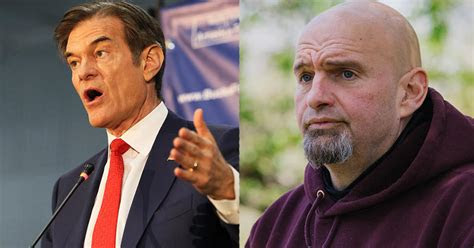
Before last week, it appeared the 2022 Republicans would win majority pickup for the U.S. House—which has always been the case—but the White House Democratic Party would hold the U.S. Senate. This was attributed to the Republicans potentially failing to hold Pennsylvania.
Pennsylvania is currently in the Republican column for retiring Pat Toomey. Nominee Mehmet “Dr.” Oz, above left, is no seasoned professional campaigner. He has been lackluster. He has been silly. But with enough wind, nationally, going against Joe Biden and his White House Democratic Party is why this electoral wizardry can happen. So Oz’s Democratic challenger, lieutenant governor John Fetterman, is seeing his previously comfortable lead, in effect for several months, dissipate. This race, highly related to a national wind, is trending toward Oz.
John Fetterman, 53, suffered a stroke several months ago. For some: His abilities are in question. But, even if Fetterman had not experienced his stroke, and even if his party’s nomination would have gone instead to corporate-appealing congressman Conor Lamb, this would likely produce the same result.
The last three midterm elections in which the U.S. Senate flipped to the White House opposition party were in 1994, 2006, and 2014. The White House party, in each cycle, failed to counter-flip any opposition-party-held seats. (Last exception: 1986.) A 2022 Republican majority-control pickup of the U.S. Senate should logically begin with retaining all party-held seats before winning pickups.

Where I sense the Republicans will flip—and get their tipping-point 51st U.S. Senate seat—is Nevada.
In 2022 Nevada, Republican nominee—and 2018 gubernatorial nominee—Adam Laxalt is poised to unseat Democratic incumbent Catherine Cortez Masto.
In 2016, Catherine Cortez Masto was the handpicked candidate by predecessor and former majority leader Harry Reid. But she had a major electoral flaw no other Democrat has had, in almost 15 years, in statewide Nevada: She failed to carry Washoe County.
Washoe County’s county seat is Reno. It and Clark County (Las Vegas) are the two most-populous counties in Nevada. They combine for nearly 85 percent of the state’s population. When Barack Obama won his Democratic pickup of the presidency in 2008, and one of his pickup states was Nevada, he flipped and carried Washoe County…and became the first from his party to carry it since 1964 Lyndon Johnson. Since 2008 Obama, Washoe County has been in the column for his re-election (in 2012) as well as for Hillary Clinton (2016) and Joe Biden (2020). This also applies to winning U.S. Senate Democrats Harry Reid (2010) and Jackie Rosen (who unseated Republican incumbent Dean Heller in 2018). Washoe County also carried for 2018 Democratic gubernatorial pickup winner Steve Sisolak. For a Democrat to win Nevada’s two most-populous counties…that renders a Republican unlikely to prevail statewide.
The 2016 U.S. Senate election in Nevada saw Catherine Cortez Masto win with a raw-vote margin of +26,915. (She won Clark County by +82,445 raw votes. Republican nominee Joe Heck carried Washoe County by +1,683 raw votes.) Just over 1 million votes were cast statewide. This makes the 2022 Democratic incumbent vulnerable to a loss.
In a friendly-to-your-party electoral environment, it is not difficult to make up these numbers. It also helps 2022 Republicans that Nevada Democrats are not popular. (This was covered in a recent Breaking Points segment.) Nevada may lose one of its current delegation of 3–1 U.S. House seats. (Cook Political Report has two of its districts rated as Tossups.) Nevada Democrats are also vulnerable to losing their party-held governorship. (Although I am not including gubernatorial predictions, in this blog topic, I am leaning to predicting that outcome.)
The path to winning Nevada for 2022 Republican nominee Adam Laxalt is this: increase 2016-to-2022 Republican performance in Washoe County; lower the 2016-to-2022 Democratic margins in Clark County; and send the 2016-to-2022 raw-vote numbers in the rest of the state’s counties—all in the 2016 Republican column—further north. This would, mathematically, be enough to deliver the state to Laxalt; deliver it in a Republican pickup; and with Pennsylvania a 2022 Republican hold, this would deliver new majority control for the U.S. Senate to the Republicans.
This would not be all up to Adam Laxalt. Credit would also go to the voters in Nevada. If they want to make this happen—that they don’t want the Democrats to retain their current level of electoral power—they will especially be the ones who deliver.
I consider this scenario—holding Pennsylvania and flipping Nevada—to be the 2022 Republicans’s path to winning new majority control for the U.S. Senate. This is before giving further consideration to the race in Georgia between Democratic incumbent Raphael Warnock (a pickup winner, from a special election, in 2020) and Republican challenger and former pro-football star Herschel Walker. That particular race, in a state which requires 50 percent, may not be decided on Election Day. A runoff would be scheduled for Tuesday, December 6, 2022. And it is there that Walker may become best-positioned to unseat Warnock and deliver a 52nd seat to a majority-pickup-winning Republican Party. If it turns out to be even worse for 2022 U.S. Senate Democrats, they are vulnerable to a loss with Republican nominee Blake Masters potentially unseating Mark Kelly for a 53rd seat in Arizona. (I lean toward predicting narrow re-election for Kelly. But, due to national circumstances, I have to rate it a Tossup.)
I can give a breakdown on some details based on historic pattern.
The 17th Amendment, which allows direct elections of U.S. senators by the states’s voting citizens, dates back to the 1910s.
The midterm elections of 1914 to 2018 numbered 104 years and 27 such cycles. The White House opposition party won the overall net gains—combining U.S. House and U.S. Senate—in 24 of those cycles. Of these 24 cycles, there were 8 in which the U.S. House flipped to the White House opposition party. Of these 8 cycles, there were 3 in which the U.S. House but not the U.S. Senate flipped to the opposition party. (They occurred in 1930, 2010, and 2018.) The remaining 5 resulted in both the U.S. House and U.S. Senate having flipped to the opposition party. (They occurred in 1918, 1946, 1954, 1994, and 2006.)
When the White House opposition party established new majorities, their percentages of seats—for both houses—have tended to be a close correlation. In each case, the newly re-empowered opposition party established a higher percentage of U.S. House than U.S. Senate seats. And, for comparison, there has typically been no greater than 4 percent.
Here were those past results:
• The 1918 Republicans, beginning in 1919, established 55.17% (for 240 of 435 seats) in the U.S. House and 51.04% (for 49 of 96 seats) in the U.S. Senate.
• The 1946 Republicans (on the watch of Democratic incumbent U.S. president Harry Truman), beginning in 1947, established 56.55% (for 246 of 435) seats in the U.S. House and 53.12% (for 51 of 96) seats in the U.S. Senate.
• The 1954 Democrats, beginning in 1955, established 53.33% (for 232 of 435 seats) in the U.S. House and 51.04% (for 49 of 96 seats) in the U.S. Senate. (For these 1918, 1946, and 1954 U.S. Senate seats, at 96, keep in mind Alaska and Hawaii had not yet become the 49th and 50th states admitted into the union.)
• The 1994 Republicans, beginning in 1995, established 52.87% (for 230 of 435 seats) in the U.S. House and 52% (for 52 of 100 seats) in the U.S. Senate.
• The 2006 Democrats, beginning in 2007, established 53.56% (for 233 of 435 seats) in the U.S. House and 51% (for 51 of 100 seats) in the U.S. Senate.
Considering these outcomes, the historic averages for the numbers and percentages of seats were:
• U.S. House: 234.625 seats and 53.93 percent of seats
• U.S. Senate: 51.63 percentage of seats
I get the sense the 2022 Republicans, with majority-control pickups for both houses of Congress, will establish close to the historic averages with the following beginning in January 2023:
• U.S. House: 235 to 244 seats. (This would be 54 to 56 percent of the seats.)
• U.S. Senate: 51 to 53 seats. (This would be 51 to 53 percent of the seats.)
Look for these potential outcomes in the four separate states of the regulars here at Progressives Chat:
• Missouri (TowerofBabel): The state is solidly aligned to the Republicans since George W. Bush’s 2000 Republican pickup of the presidency and Missouri. A national Republican wave would mean solidifying party-level support in this state. (Republican shifts as well in nearly all states.) Now-retiring Roy Blunt’s last re-election to the U.S. Senate, in 2016, was by a low +2.79 percentage points. (This occurred while Republican presidential pickup winner Donald Trump carried the state by +18.51.) So, 2022 nominee Eric Schmitt should experience a conspicuously higher margin. (FiveThirtyEight recently estimated +18. It can go higher.)
• Oregon (cathyx): I sense Republicans will win a pickup of the governorship—specifically for nominee Christine Drazan—and this would be the first for the party since 1982. The party will flip the state’s 5th Congressional District. Thanks to the 2020 U.S. Census Bureau’s report including changes with populations, Oregon has gained +1 congressional district (and likewise electoral vote). Pre-2022, the state’s U.S. House delegation is 4–1 in favor of the Democrats. Post-2022, I estimate an outcome of 4–2. This would change the percentage of Oregon’s Democratic-held U.S. House seats from 80 to 66 percent. The only likely Democratic hold, at this point, is re-election to the U.S. Senate for Ron Wyden.
• Wisconsin (The_Fixer): Nowdays one of the nation’s best bellwether states—and the 2016 and 2020 U.S. presidential elections’s tipping-point state—Wisconsin should well-reflect overall 2022 national outcomes. In this respect, I think it will not disappoint. The state’s Republican incumbent and senior U.S. senator, Ron Johnson, will win re-election. (His margin will likely be more comfortable than what numerous polls had reported.) The state’s 3rd Congressional District (retiring Democratic incumbent Ron Kind) will flip Republican. That will change Wisconsin’s U.S. House delegation from 5–3 to 6–2 in favor of the Republicans. This would change the percentage of the state’s U.S. House delegation, favoring the Republicans, from 62.50 to 75 percent. Like with the 2022 Pennsylvania U.S. Senate election, Wisconsin’s gubernatorial election is a Dead Heat. If much of the estimated outcomes play out, Democratic incumbent Tony Evers may become unseated by Republican challenger Tim Michels. (That race is a tough call.)
• Michigan (Candy83): In the presidential elections of 2016 and 2020, and the midterm elections of 2018, Michigan well-matched its popular vote with the U.S. Popular Vote for U.S. House. (For 2020, it was the one pickup state, for U.S. President, to best-match its statewide margin vs. the national.) The Republicans don’t have the gubernatorial nominee, in Tudor Dixon, it needs to unseat Democratic incumbent Gretchen Whitmer. (The best would have been former Detroit police chief James Craig. He, like numerous other Republican candidates, was rejected ballot access for the primaries due to the state determining numerous, submitted signatures were fake.) Whitmer—a 2018 Democratic pickup winner with a statewide margin of +9.56 (north of +400,000 raw votes)—is likely to win re-election with lower margins. (Some polls suggest this race could become tighter and change to a Tossup.) Michigan also lost –1 congressional district (and likewise electoral vote). Pre-2022, its U.S. House delegation is an Even 7–7. I sense it will change to 7–6 (perhaps even 8-5) in favor of the Republicans. Cook Political Report rates the state’s 7th Congressional District (Democratic incumbent and CIA agent Elissa Slotkin) a Tossup. The state’s 3rd Congressional District (which includes Kent County and its county seat Grand Rapids) is generally trending Democratic—it flipped in 2018 for Gretchen Whitmer and a re-elected U.S. senator Debbie Stabenow and in 2020 for Joe Biden (and it votes in presidential elections like Nebraska’s 2nd Congressional District)—has been targeted by the DCCC in its Red-to-Blue strategy. This is the district of Peter Meijer, a family member of the Meijer stores, who was ousted in the Republican primaries by John Gibbs who, as it turned out, received campaign money from the Democrats. This may turn out to be, like with Hillary Clinton’s 2016 presidential campaign, another Pied Piper strategy gone wrong.

It was 40 years ago, with the timing in September and October 1982, which marked the Tylenol Murders.
This case, which is officially not solved, happened in and around Chicago, Illinois.
Bottles of Tylenol Extra Strength, at which time were in capsule form, were tampered with and injected with cyanide.
The Tylenol Murders claimed the lives of seven, including three family members (two who later took from the same bottle belonging to the deceased first), and it required detective-like work by nurse Helen Jensen—after those family members died—to figure out it was the pills. (She worked the case with now-retired Chuck Kramer, now 81, at which time he was a fire department lieutenant in Arlington Heights.) All the victims, including one child, were under the age of 40. As now-retired Jensen, now 85, tells it: Her theory was initially dismissed. “I went back to the emergency room, presented it [the theory of that particular bottle of Tylenol pills being poisoned] to the medical examiner and the police, and they laughed at me.” Jensen also described the case as follows: “It was probably one of the first acts of domestic terrorism.”
I was 11 years old. My sense of this, at the time, was a panic which had people—from everywhere—figuring this could happen anywhere. (It did quite a hit job on the business of Johnson & Johnson. The manufacturer recalled more than 30 million bottles.)
My late paternal grandmother, who regularly watched local and network news, would often say, for any news reports involving destructive and sickening crimes, “What is this world coming to?”
With the timing on the calendar closely connected to Halloween, this also changed—to some extent—how parents handled allowing their children to celebrate the holiday; whether to continue their neighborhood Trick-or-Treating tradition for its intended fun…and for the candy. (Frankly: It was even before 1982. The 1981 film sequel Halloween II includes a scene of a boy taken to the hospital by his mother because he came in contact with a tampered product.)
One thing good came from this: It changed the industry for the ways it packages over-the-counter medicines and other products.
There is a podcast (to which I will not provide a link; it came to my attention only shortly before having completed writing and setting this blog topic to publish), and it is titled Unsealed: The Tylenol Murders (AT WILL MEDIA, The Chicago Tribune). I have not yet listened to it. It has several episodes. I intend to check out, at the very minimum, its first.
I encourage interested readers to not only watch the above video, which is a news segment by CBS Chicago (WBBM–TV, Ch. 02), but to also read some material which follows this paragraph (for some more general information).
