Last week, actually late night Thursday/Friday [September 13/14, 2018], the first part of an interview on The Jimmy Dore Show with the host and U.S. Tulsi Gabbard (D–Hawaii #02) was posted.
Since the end of the first part revealed there would be more parts, but without mentioning how many, it was too late for me to make that the blog entry for Friday, September 14, 2018. (The competition of the rest of the videos were published after that date.) But, I definitely wanted to schedule a blog entry posting all video parts of that Dore–Gabbard interview.
This past Monday [September 10, 2018], I wrote the blog entry “Coming Up: U.S. House.” Now, here is a focus on the U.S. Senate. (The above is from Real Clear Politics, update from this past Saturday, September 8, 2018, on the apparent status.)
I did my own research of looking into the average number of seats gained with each nationally shifted percentage point from the midterm elections which flipped the U.S. Senate and governorships to the White House opposition party. It is not worth mentioning in detail. Typically between +1 to +1.5 seats are gained with each nationally shifted percentage point.
On the U.S. Senate schedule, for 2018, is Senate Class #01. They were last on the schedule in 2012, when then-Democratic incumbent U.S. president Barack Obama won re-election. The Democrats, heading into that election with 53 seats, won a net gain of +2, for 55 seats.
Under the premise of a 2018 majority pickup of the U.S. Senate for the Democratic Party, there are some things to keep in mind.
In 2016, California began its system of advancing to the general election the two candidates who received the most votes. This is without regard for party affiliation. So, in 2018 California, just as it was in 2016, the two general-election nominees come from the same party. So, I wouldn’t adhere to assuming a past pattern of expecting the 2018 Democrats to have to increase their 2012 U.S. Popular Vote margin by an additional two or three points.
The last three midterm elections in which the U.S. Senate flipped to the White House opposition party were: 1994 Republican (off Democratic president Bill Clinton), 2006 Democratic (off Republican president George W. Bush), and 2014 Republican (off Democratic president Barack Obama). They all have the following in common: Heading into the elections as the minority party, the 1994 and 2014 Republicans and the 2006 Democrats did not lose a single party-held seat.
If the 2018 Democrats flip the U.S. Senate, my guess is about 17 to 20 will overperform their 2012 margins. I’m estimating between 70 to 80 percent of party-held seats will overperform. Among the re-nominated Democratic U.S. senators likely to underperform: Missouri’s Claire McCaskill, New Jersey’s Bob Mendendez, and West Virginia’s Joe Manchin. North Dakota’s Heidi Heitkamp has nearly nowhere to go to decline if she is to pull off winning re-election. But, for a little while now, Florida’s Bill Nelson, who won by over +1 million raw votes, is in a tossup against the state’s current governor, Rick Scott.
If the 2018 Democrats flip the U.S. Senate, nearly all the 2012 Republican-held seats would underperform. Although I have sensed Utah’s Mitt Romney can overperform retiring incumbent Orrin Hatch’s 2012 margin, a 2018 Romney was recently polled at +26, down from Hatch’s +35.33. In 2012, as the Republican presidential nominee, Romney carried Utah by +47.88 percentage points.
One of these Republican-held states’ seats ranks in the Top 10 for population: Texas. In 2012, Ted Cruz (+15.84), who won the Lone Star State +0.06 above presidential nominee Mitt Romney (+15.78), is severely underperforming in the polls. That race is rated between a tossup and Lean Republican hold. For Top 20 populous states Arizona and Tennessee, the former is rated a Democratic pickup (for Kyrsten Sinema) while the latter is polling with a conspicuous Democratic shift. Tennessee’s retiring Republican incumbent Bob Corker (whose 2012 re-election margin was +34.48 to Mitt Romney’s +20.38) is followed by a race between would-be Republican successor and congresswoman Marsha Blackburn vs. Democratic nominee and former governor Phil Bredesen. It is rated a tossup. Put into a 2012-to-2018 perspective: Texas’s Ted Cruz, who won by over +1.2 million votes, and Tennessee’s Bob Corker, who won by over 800,000 votes, combined for +2 million votes vs. the tossup status of Florida Democratic incumbent Bill Nelson’s +1 million.
It is unrealistic to perceive a national 2012-to-2018 shift for U.S. Senate—and on the watch of Republican incumbent president Donald Trump—in the direction of the Republicans. (Meaning, the U.S. Popular Vote for U.S. Senate.) It will likely be a 2018 Democratic shift. When you put this all together, it is not difficult to imagine the 2012 Democrats shifting sufficiently to also yield the pickups of the two seats they need to flip for a new majority. As of September 14, 2018, I would estimate the U.S. Senate is a tossup. But, the advantage is with a Lean Democratic pickup. Since the midterm elections of 1946, when Republicans won majority pickups of both houses of Congress, it was only in 2010 that the U.S. Senate did not flip with the U.S. House. Below is the estimated map should the 2018 Democrats succeed in winning a majority-control pickup of the U.S. Senate. Light blue: Democratic pickup. Brown, which would normally be yellow, are apparent tossups.
UPDATE, 09.16.2018, @ 01:15 p.m. ET:
• On Monday: “Jimmy Dore Interviews Tulsi Gabbard.”
The general election for the 2018 midterm elections are now eight weeks away.
I wrote about the Democrats needing to win the U.S. House (that is U.S. Popular Vote for U.S. House) by +7 in percentage points margin here: Democrats Magic Number: +7.
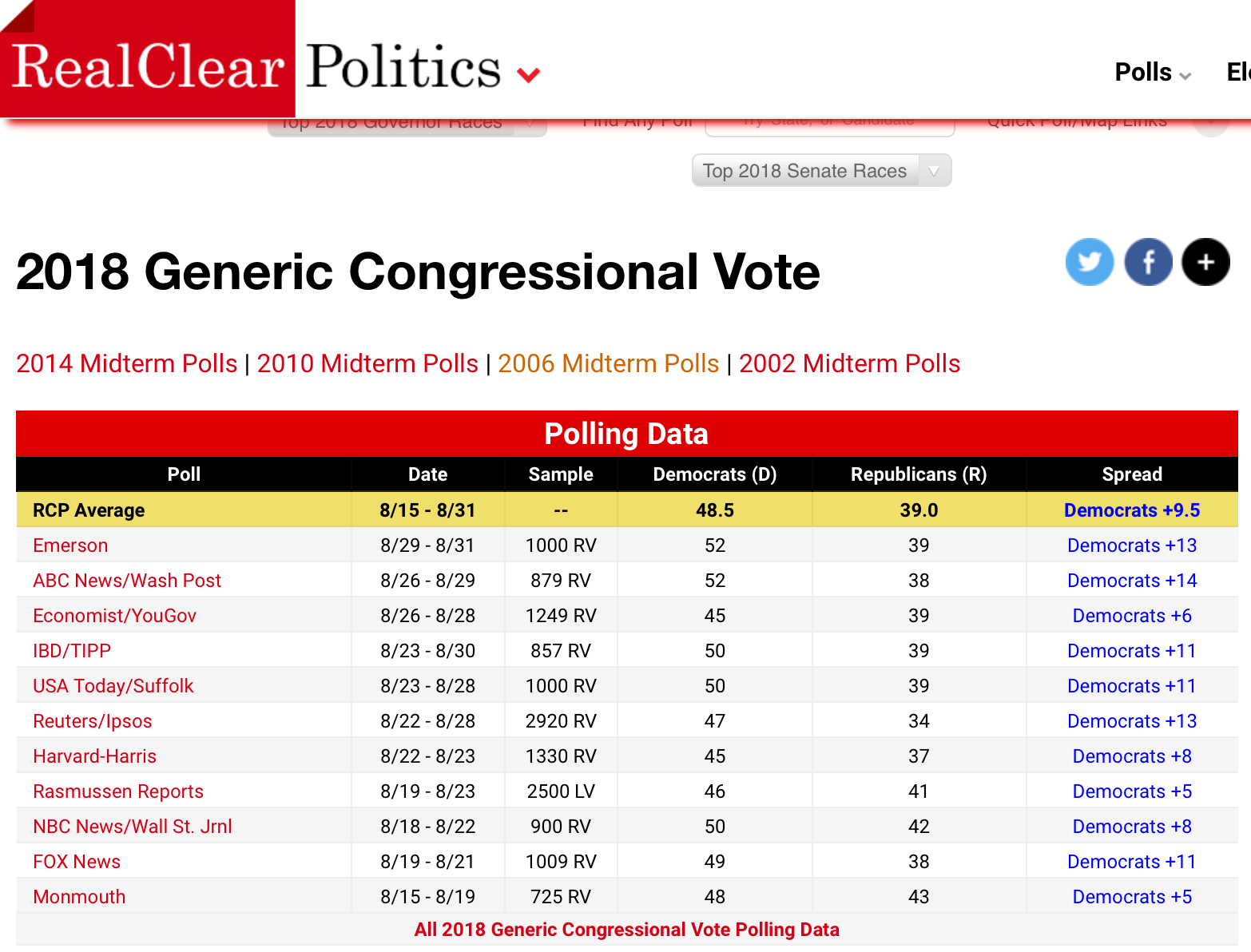
Over the last week, Real Clear Politics has updated its “Generic Congressional Vote.” This is for U.S. House. The Democrats, in position to flip the U.S. House, are leading by, from these three reports (between August 15 to September 4,, 2018), +9.5 +8.3, and +7.8 percentage points. That is an average of +8.53. Or, if you will, Democratic +8.53.
Looking at those poll numbers, I find it funny that Rasmussen Reports tends to skew Republican, and has had that reputation for over 10 years, and that three of those listed conduced polls during Labor Day weekend (and two apparently on Labor Day, which was September 3, 2018).
I will go by the average reported (by those three): +8.53.
Since the historical number of seats gained with each nationally shifted percentage point (over the midterms of 1946, 1954, 1994, 2006, and 2010) has been +3.59—and that I take into account the 2016 Democrats lost the U.S. Popular Vote, for U.S. House, by –1.08 (it was 49.11% for the Republicans; 48.03% for the Democrats)—here is the math:
This Saturday [September 8, 2018] marks the 77th birthday [born in 1941] of independent Vermont U.S. senator and 2016 Democratic presidential candidate Bernie Sanders.
The general election of the 2018 midterm elections are two months from this week. The scheduled date is Tuesday, November 6, 2018. (I have another related post coming next Monday.)
The title of this blog entry points to this quick summary: Whichever of the two major political parties wins on the counts of U.S. Senate, U.S. House, and Governor—and this means majority numbers—are going to achieve with Florida.
Here is a fact not many election pundits realize or, if they do, tend to not mention: Since after the 1994 midterms, and starting with 1995, the party which had the majority in the U.S. House also had the majority number of governorships. This means there is importance with the governorships, for Democrats wanting to flip both houses of Congress, which are also critical. The governorships are also important for state houses. They are also important for a possible setup of the next presidential election of record in which the presidency flips from the Republican to the Democratic column (which, at this point, I guess not to be with an unseating of Donald Trump in 2020 but with an open race in 2024).
The last Democratic gubernatorial win in Florida was Lawton Chiles, with his second-term re-election, in 1994. He died in office in December 1998. Just before that, Jeb Bush won a Republican pickup, in November 1998, and was re-elected in 2002. Charlie Crist made it three-in-a-row for the GOP in 2006. Rick Scott, with margins of only +1.15 and +1.07 percentage points, won in 2010 and 2014. So, the Democrats—in what should be a midterm elections wave here in 2018—are looking to end their losing streak of Florida governor races in what is also a long-established bellwether state (since 1928, with exceptions of 1960 and 1992, it has carried for all presidential winners). For the Democratic Party, this is alarmingly overdue.
On Tuesday, August 28, 2018, Tallahassee mayor Andrew Gillum, above, won the 2018 Florida Democratic gubernatorial nomination with 34.3 percent of the vote. Congresswoman Gwen Graham, the daughter of formergovernor and U.S. senator Bob Graham, came in second with 31.3 percent. They were followed by Miami Beach mayor Philip Levine, at 20.3 percent, and real estate billionaire Jeff Greene, at 10.1 percent.
When you get at least four people seeking a party’s nomination, and that fourth-place candidate finishes with 10 percent of the vote, it is remarkable the winner can prevail with that 3-point margin, over the top runner-up, and also win key counties. Given he was also the lowest-funded candidate in the race, it says a lot about the candidate himself. This is a lot of credit earned by Andrew Gillum.
Here is a screen shot of the 2018 Florida Democratic Gubernatorial Primary:
Andrew Gillum carried the southeast populous counties Miami–Dade (Miami), by +6 over Levine; Broward (Fort Lauderale), by +12.1 over Levine; and Palm Beach (West Palm Beach), by +0.5 over Graham. In the middle areas of this Florida map, along the I–4 corridor, Gillum also carried Hillsborough (Tampa)—which is a bellwether-to-the-state county (at least in presidential elections)—by +5.4 over Graham. He also carried Orange (Orlando), by +9.9 over Graham. In the northern region, Gillum naturally carried his home county, Leon (Tallahassee), by +7.5 over Graham. He also won Duval County (Jacksonville), by a landslide +27.6 over Graham. (In raw votes, Gillum outpaced Graham there by more than double their votes. Given the Republican side, with the nomination won by Donald Trump-endorsed Ron DeSantis, the congressman from Florida #06 who was in a two-person primary race over ex-congressman Adam Putnam, Gillum had a better Duval County margin than DeSantis, who won Duval County by +26.6.)
Duval County, at the presidential level, has been trending away from the Republicans over the last five presidential elections: In 2000, it was +16 percentage points more Republican than the state of Florida. In 2004, it was +11. In 2008, as Barack Obama flipped the state by nearly +3 percentage points, Duval County was +5 points more Republican. It was at that level, again, in 2012. And in 2016, Donald Trump flipped the state by +1.19 points and won Duval County by +1.36, a spread of a mere 0.17 points. So, this county is trending away from the GOP. If Andrew Gillum wins a 2018 Democratic pickup of the Florida governorship, Duval County may flip with the state of Florida.
There is more to consider. Andrew Gillum was backed by Bernie Sanders. Hillary Clinton did not also endorse Gillum. So, this is an example of the test we will be seeing of a Bernie-endorsed candidate and nominee trying to win a statewide general election. Not an ordinary state. The No. 3 most-populous state in the nation. And a bellwether state. While there are corrupt, corporate Democrats ratfucking Ben Jealous’s attempts to unseat Larry Hogan for Governor of Maryland, the 2018 Democrats can’t win back power without Florida. They cannot expect to flip the U.S. Senate if incumbent Democrat Bill Nelson—re-elected to his third term in 2012 by over 1 million votes and +13 percentage points (while Barack Obama was re-elected with Florida by margins of nearly 75,000 votes and +0.88 points)—gets unseated by Republican challenger and current governor Rick Scott. (Scott has gone after Nelson to a point where the governor has some polls showing him slightly ahead of Nelson, who has no business—in what is supposed to be a 2018 Democratic midterm wave—getting unseated.)
Establishment Democrats—who want to control as much as they can inside their party (for who exactly can win nominations particularly in key races from the presidency on down)—would have preferred nomination for Gwen Graham. The nominee is Andrew Gillum.
Let us keep in mind the following:
•The Democrats want the U.S. House. Okay. That starts with 2016 Hillary Clinton’s carried 20 states, minus those (like Massachusetts and Connecticut), which have 100 percent Democratic-held seats, before going to the six 2016 Republican pickup states for Donald Trump: Florida, Iowa, Michigan, Ohio, Pennsylvania, and Wisconsin (as well as Maine #02, where incumbent Republican Bruce Poliquin is in a tossup race). The 2018 Democrats will likely not flip the U.S. House while no seats in Florida come along for the ride. It has been polled, for more than a year, that retiring Republican Ileana Ros–Lehtinen’s 27th Congressional District will flip Democratic. Republican incumbent Carlos Curbelo, from Florida #26, has been polling in position to become unseated.
•The Democrats want the U.S. Senate. Okay. The last three midterm elections, in which the upper chamber flipped to the White House opposition party, were 1994 (Republican pickup off Democrat Bill Clinton); 2006 (Democratic pickup off Republican George W. Bush); and 2014 (Republican pickup off Democrat Barack Obama). In each case, the minority party heading in ended up not losing a single party-held seat. The Democrats, with 49, would achieve a new majority by holding all their seats and winning pickups with Nevada (unseating Dean Heller by Jacky Rosen) and Arizona (open race with Martha McSally failing to hold via pickup by Kyrsten Sinema). The Democrats are also in striking distance in Tennessee and Texas. In 2012, Texas’s Ted Cruz won by over 1.2 million vote and +15.84 percentage points, and Tennessee’s retiring Bob Corker won by over 800,000 votes and +34 percentage points. Combined, Cruz and Corker won by 2 million votes—and those seats are rated between tossup and Lean Republican hold. The 2018 Democrats should not be getting counter-flipped—especially with Nelson—when three of the eight states won by the 2012 Republicans are Top-10 [Texas] and -20 [Arizona, Tennessee] populous states which are shifting sharply toward the Democrats. The 2018 Democrats are not likely to flip the U.S. Senate if Bill Nelson gets unseated.
•The Democrats should want to win a new majority count of governorships. Following the November 2017 pickup of New Jersey, the 2018 Democrats have 16. They need a pickup of +10 to reach a new majority with at least 26. Recent polls have the Republicans not flipping a Democratic-held governorship but possibly achieving with the independent-held Alaska. But, that would still keep the Democrats at 16 and in need of a net gain of +10. Four states are more immediately in position to flip: Illinois, New Mexico, Maine, and Michigan. (Republican incumbents Bruce Rauner, so severely unpopular and poised to become unseated, is followed by term-limited Susana Martinez, Paul LePage, and Rick Snyder as nooses around the necks of their would-be party successors.) Real Clear Politics has a list of tossup states which are all currently in the Republican column. If the Democrats win over a new majority, they will reach with the inclusion of Florida. My estimate of likelihood are: (21) Nevada; (22) Florida; (23) Wisconsin; and (24) Ohio. To reach the tipping point, that 26th state, look to (cited alphabetically): Arizona, Georgia, and Iowa. Beyond the new majority: (28) Kansas. Requiring a tidal [national] wave: Maryland, Oklahoma, and Tennessee.
There is something delicious to this. Establishment Democrats—those who thwart and/or sabotage progressives (or, more to the point, those more progressive to the establishment’s comfort)—will not be able see their political party re-empowered, with the results of Election 2018, without Florida. This means they need Andrew Gillum. And it may turn out—once Election Night arrives and passes, and we see which party prevails on each of the three above counts—the best bellwether state for the midterm elections of 2018 will be Florida.
I will leave this blog entry with was an insightful, early-August 2018, The Young Turks “Rebel HQ” interview between host Cenk Uygur and guest Andrew Gillum.
This past June, I reduced posting blog entries to no more than two days per week.
I made that decision when I was approaching a vacation, during the second week of June, and I anticipated that I may not feel like preparing more blog entry postings on a three-days-per-week schedule.
I have found, during this summer, that I haven’t been feeling much up to posting blog entries more than two times per week. Sometimes, I don’t know what to write. But, when I come up with a blog entry, I write at least a little something related to a given blog entry which gets posted.
This two-days-per-week summer schedule has actually worked out better than I expected. (I have noticed a really good amount of comments.) This simply divides—but organizes—a given week into two parts: the beginning of the work week [Monday]; the end of the work week [Friday].
Beginning in September, I am going to drop labeling Friday blog postings as “Open Weekend” or “OW” (short for Open Weekend). There is no point to continuing with it. I started Progressives Chat last September 25. So, counting this month of August, there have been twelve consecutive months of including an Open Weekend. That is, in a way, enough to call that a year.
Thank you, to everyone, and I wish you all a safe and pleasant Labor Day Weekend.
On the Progressives Chat list of Recommendations is the discussion site Jackpine Radicals (link:https://jackpineradicals.com). Although this was delayed, because of other topics needing to be posted as blog entries, I offer a July 7, 2018 thread which was interesting: “The Vichy Democrats” (link:https://jackpineradicals.com/boards/topic/the-vichy-democrats/). The topic author is Ohio Barbarian. It was a look at the current Democratic Party [Establishment] being a reminder of Vichy France from the period when Adolf Hitler was chancellor of Germany. Here is a screen shot from that opening post. (This is just a part of that thread’s opening post.) I welcome readers to offer their two-cents in reaction to that thread.